Additive Manufacturing
At KERRIUM, we see high-temperature alloy additive manufacturing as a major industrial shift driven by the convergence of advanced metallurgy, aerospace engineering, and digital manufacturing.
Today, the industry is centered around several core technology pathways:
1. LPBF (Laser Powder Bed Fusion) — The Current Mainstream
LPBF is currently the dominant technology for high-temperature alloy 3D printing, especially in aerospace and energy applications.
It is widely used for:
- Turbine components
- Rocket engine parts
- Combustion chambers
- Heat-resistant structures
The current frontier is shifting from standard alloys such as Inconel 718 toward more difficult hot-section materials including:
- CM247LC
- Rene 41
- IN738
- GTD222
At KERRIUM, we believe the ability to reliably process these advanced superalloys will become a major competitive barrier in next-generation aerospace manufacturing.
2. EBM (Electron Beam Melting)
EBM uses electron beams in a vacuum environment, offering:
- Lower residual stress
- Reduced cracking risk
- Better thermal stability
Although LPBF currently leads the market, EBM remains important for crack-sensitive high-temperature alloys and aerospace hot-section applications.
3. DED (Directed Energy Deposition) — Fastest Growth Area
DED deposits metal powder or wire directly into a melt pool and is gaining strong momentum for:
- Large-scale structures
- Repair and remanufacturing
- Aerospace maintenance
- Energy-sector components
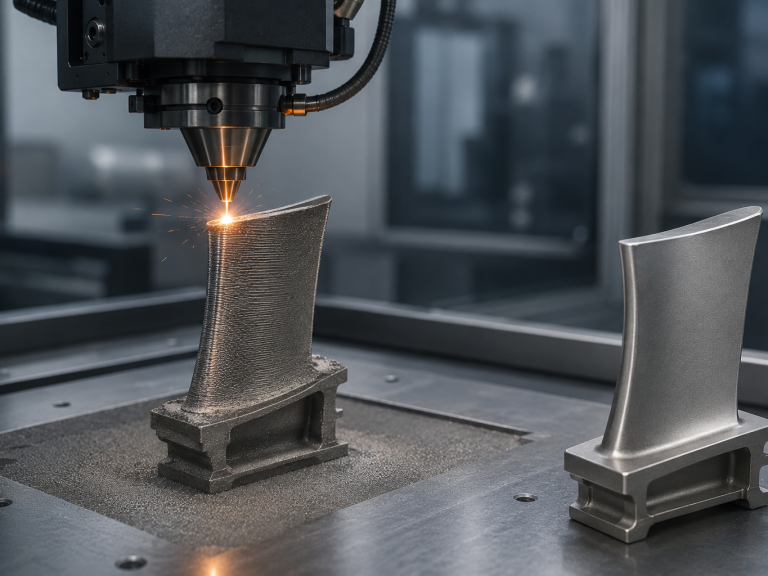
Key branches include:
- Laser DED
- WAAM (Wire Arc Additive Manufacturing)
At KERRIUM, we see DED as one of the most commercially promising segments for future industrial-scale additive manufacturing.
4. Binder Jetting & Solid-State Additive
Binder Jetting is attracting interest for low-cost, high-throughput metal production, though high-temperature superalloys remain difficult due to sintering and porosity challenges.
Meanwhile, emerging solid-state approaches such as Cold Spray AM may offer long-term solutions for reducing thermal cracking and residual stress.
At KERRIUM, our attention goes beyond hardware. We closely follow:
- Advanced superalloy systems
- Additive manufacturing process intelligence
- AI-driven quality control
- HIP and heat-treatment integration
- Digital metallurgy and traceability infrastructure
We believe the next phase of competition will not be defined by machines alone, but by the integration of materials science, process data, and digital manufacturing ecosystems.
The future of high-temperature alloy additive manufacturing will be shaped by certified production, advanced alloy development, and intelligent process control — areas where KERRIUM continues to maintain strong strategic interest and long-term research focus.