Beyond Alloy Grades:
What EUROCORR 2026 Tells Us About Corrosion-Resistant Materials
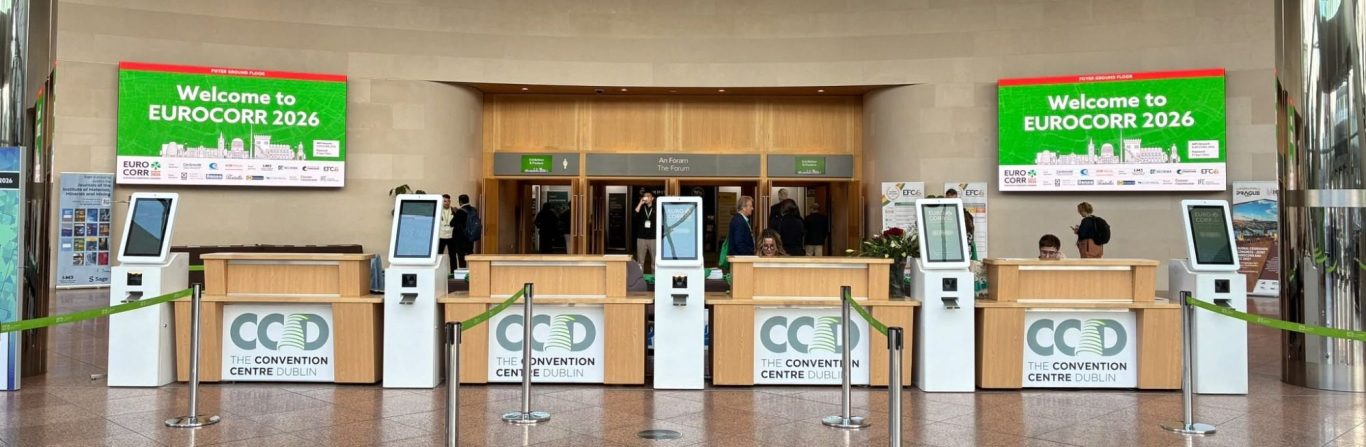
EUROCORR 2026 in Dublin reinforced a clear trend in advanced materials engineering:
the key question is no longer simply which alloy grade performs best, but which material condition remains stable in a specific service environment.
Across the technical programme and poster exhibition, mature nickel alloys, stainless steels and other corrosion-resistant materials were repeatedly studied under increasingly realistic conditions: elevated temperature, weldments, complex gas atmospheres, molten salts, hydrogen, ammonia, wear and surface degradation.
This suggests a broader shift from alloy selection toward environment–material interaction.
From chemistry to service condition
Traditional material selection often starts with composition, mechanical properties and standards. These remain essential, but they are no longer sufficient for demanding applications.
EUROCORR presentations on Alloy 625 oxidation, metal dusting, carburization and weldment behaviour show that long-term performance also depends on processing history, microstructure, surface state and exposure conditions.
In practice, two materials with the same UNS designation may behave differently if their heat treatment, fabrication route or service environment differs.
Protective scales matter
Another recurring theme was the role of protective oxide scales. Research on chromia- and alumina-forming alloys, MCrAlY systems and high-temperature oxidation shows that material performance is increasingly linked to the stability, adhesion and integrity of Cr₂O₃- or Al₂O₃-based protective layers.
This changes the way high-temperature alloys should be understood: not only by nominal chemistry, but by how effectively they build and maintain a protective surface under real operating conditions.
New energy systems require new qualification
Hydrogen, ammonia, CCS and advanced nuclear systems also feature strongly. The common theme is qualification under more realistic conditions: welds, HAZ regions, hydrogen permeation, liquid ammonia, acidic CO₂ environments and long-term corrosion exposure.
For these applications, material data must increasingly describe not only the base alloy, but also surface condition, fabrication state and environmental response.
Materials data are becoming part of the product
Perhaps the most important long-term signal is the growing use of high-throughput testing, predictive modelling, digital twins and AI-enabled corrosion analysis. The immediate implication is simple: before advanced analytics can add value, materials data must first be structured.
A useful material record should progressively connect:
Heat → Composition → Processing → Microstructure → Surface → Environment → Degradation → Application Limit
That moves the material beyond a certificate and toward a traceable body of engineering knowledge.
From material supply to material intelligence
EUROCORR 2026 therefore points toward a future in which material value is increasingly determined by more than grade availability. The stronger proposition is:
material + traceability + processing history + environmental data + failure understanding.
For KERRIUM, this is the logic behind combining Specialty Materials, Research Materials and Material Intelligence. Every material has a composition. Its real engineering value begins with understanding how it was made, where it is used, and how it fails.